Bring a long conversation in as a worker
An agent you have been talking to for an hour already knows the code. Make it another agent's worker as it is, give it work, and let it go afterwards.
Goal. A Claude Code or Codex session has been reading the auth module with you and knows the decisions behind it. Instead of a fresh worker that starts from nothing, the coordinator takes that session on as its worker. Nothing is restarted, so the conversation stays.
You need
- st 0.3.70 or later, with
st hooks installdone. - Both agents in panes of sessions st shares. They can be in different sessions, or on another machine of the account (see Workers on other machines).
1. Find the session's id
In the pane of the session that is to become the worker:
echo $TMUX_PANE # %15st ls and the desktop app's agent graph show it too.
2. Adopt it
Ask the agent that is to direct it:
Adopt %15 as your worker and give it the auth tests. It already knows that module.It runs:
st worker adopt %15Or do it yourself:
- From a shell in the parent's pane,
st worker adopt %15; from anywhere in a shared session,st worker adopt %15 --parent %12. - Desktop app (0.1.21 or later). In the agent graph, drag the worker's card onto the parent's card. It says "Make <worker> a worker of <parent>".
- Sidebar (desktop app 0.1.31 or later, web terminal st 0.3.85 or later). Drag the worker's window row onto the parent's row.
st tells both agents in one line each: the parent gets the worker's id and the
commands to give it work, the worker learns whose worker it is and to report
with st worker done. From a terminal, st first asks why the agent is brought
in (or take --role "<why>"), and once the adopted agent's turn ends it asks it
for a short brief of what it has done, which st worker read then shows (st
0.3.93 or later). If the worker is on a question or permission screen, it
is adopted but not told; the result says so, and you can tell it yourself once
the screen is gone.
3. Give it work
An adopted worker has no task file. Its work comes by message, and it needs no background it already has:
st worker send %15 "Add tests for the token refresh. Done when go test ./internal/auth passes."
st worker wait %15
st worker read %15
A wait after a send waits for a new turn to start and finish, even if the
worker still carries the done mark from earlier work.
4. See it
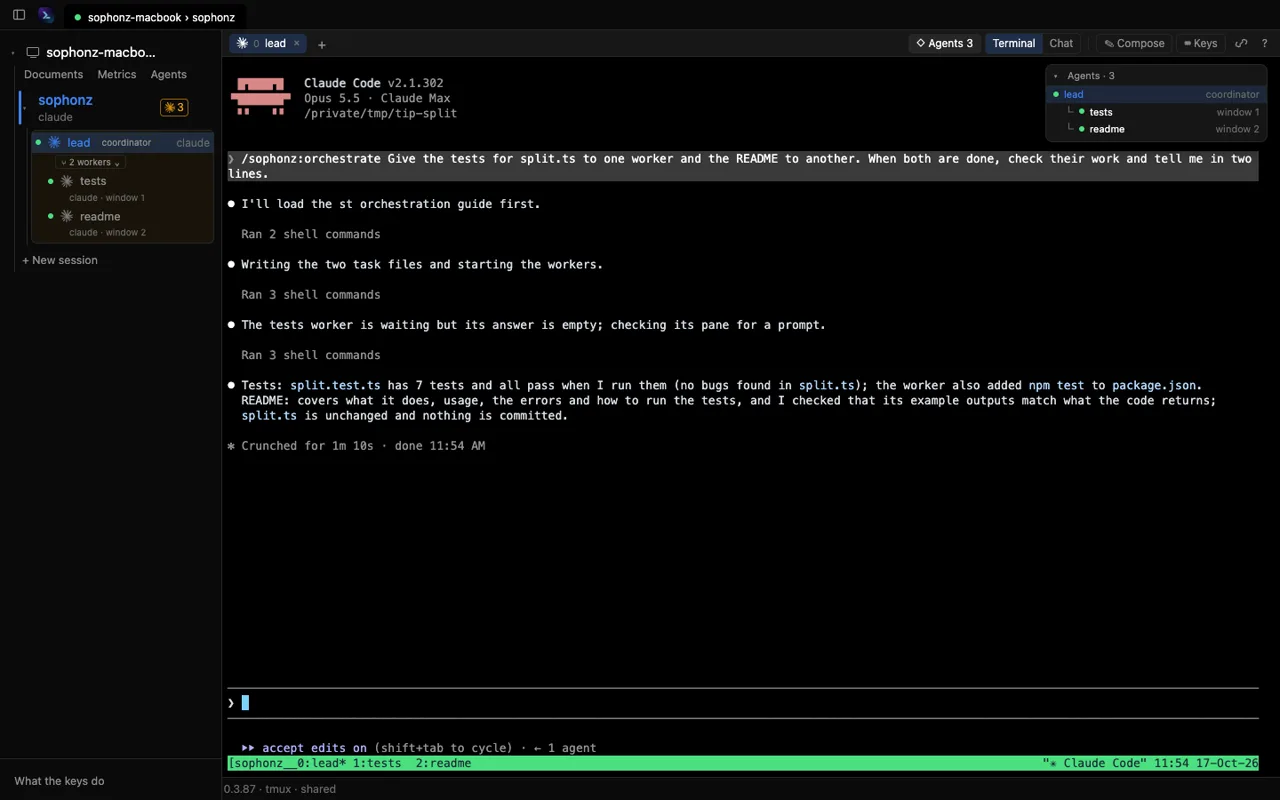
A thick green line joins the two cards in the agent graph. In the sidebar the
coordinator's row gets a coordinator badge, and its workers fold under a head
line such as Workers · 1 working.
5. Let it go
st worker release %15Or Release on the worker's card in the agent graph, or the row's menu in
the sidebar. The session goes back to being your conversation. st worker stop does not close an adopted worker: it was yours first.
- Both must be agents. Adopting itself, an agent already below it, going more than two levels below the coordinator within a run, or putting more than four agents above the worker across a chain of teams is refused (st 0.3.88 or later). An agent with workers of its own comes in as a team; see A team as a worker.
- An agent on another machine that already works for someone else must be
released first, and
--ownsis for workers on this machine.
More: Workers.